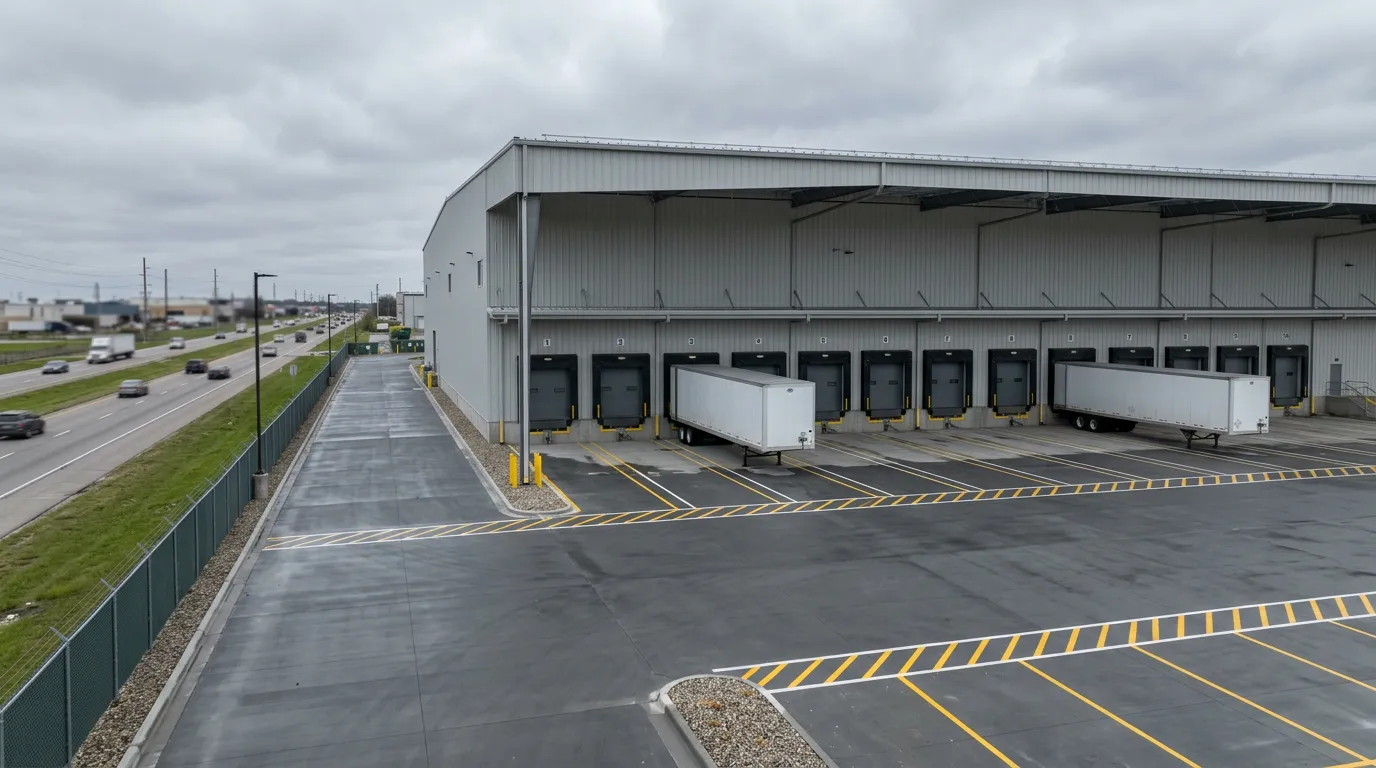
Warehouse Size Ranges
Warehouse dimensions are driven by your racking system, forklift turning radius, dock count, and site footprint. The ranges below reflect the most common configurations we build across Canada.
60–80' wide × 18–24' eave. Suits 1–3 dock doors and single-aisle racking up to 20'.
100–120' wide × 24–30' eave. Accommodates 4–8 docks, double-deep racking, and a mezzanine office.
150–180' wide × 30–36' eave. High-bay racking to 30', VNA forklift aisles, and 10–24 dock doors.
180–200'+ wide × 36–40'+ eave. Suited for automated storage and retrieval systems (ASRS), bulk rack, and large-volume commodity storage.
Rack-ready: 24–28'. High-bay: 32–40'. Design clear height equals eave height minus haunch depth.
25' bays are most common for standard selective racking. 30' bays allow wider aisles or double-deep racks without column conflicts.
Most-Requested Warehouse Sizes
The configurations below cover the majority of warehouse projects we quote. Every building is custom. Use these as a starting point and we'll tailor the design to your site.
Small distribution or light-industrial warehouse with 1-3 dock doors.
Mid-size regional warehouse with 4-8 docks and mezzanine office.
Large distribution centre with high-bay racking and multiple loading positions.
Flagship distribution or high-bay bulk storage with 30'+ clear height.
Sizing your warehouse building
Start with program, not footprint
Before you pick a width and length, list what goes inside: equipment, racking, vehicles, staff count, and future expansion. The internal program drives the building, not the other way around.
Width drives cost; length adds flexibility
Clear-span width above 80\' meaningfully increases primary frame cost. Adding length in 20-30\' bay increments is the most cost-effective way to grow square footage.
Eave height is about equipment, not aesthetics
Set eave height from the tallest object or rack plus clearance for lights, sprinklers, and crane runways. Every 4\' of added eave increases wall area and frame weight. Use our climatic data map to look up NBC 2020 loads for your site.
Plan for the future now
Designing a structure to be extended later is inexpensive at the engineering stage and expensive afterwards. If expansion is plausible within 10 years, we'll engineer the knockout end wall and foundation into the original design.
Questions about warehouse sizes
How large can a steel warehouse be?
Our steel warehouses can be built from 10,000 sq ft up to 200,000+ sq ft and beyond. Clear-span widths up to 200′ eliminate interior columns for unobstructed racking and forklift operation. Length is effectively unlimited through bay additions. Just tell us your target square footage and ceiling height.
How quickly can a steel warehouse be built?
Pre-engineered steel components dramatically shorten site construction time. A 20,000 sq ft warehouse typically erects in 4–8 weeks once the foundation is ready, versus 4–6 months for conventional construction. Lead time from order to delivery is usually 8–14 weeks depending on size and specifications.
Can I add loading docks to a steel warehouse?
Yes. Loading dock count, size, dock height, hydraulic dock levelers, and dock seals are all engineered into the building design from the start. We also accommodate drive-through doors, grade-level overhead doors, and man doors in any configuration.